Division of Integrative Systems and DesignHKUST
← All research stories

Solve / 2024

Magnetic separation

Making scalability part of the mechanism.

THE CENTRAL QUESTION

Can magnetic particles be removed quickly from a large flow without surrounding every channel with its own bulky magnet?

Magnetic separation is widely used because a magnet can collect labelled cells, particles or contaminants without direct contact. The difficulty appears when the flow channel becomes larger or the magnet moves farther away: the field gradient that pulls a particle drops rapidly. Conventional systems therefore gain throughput by repeating small channels and magnets, which makes the equipment bulky. This work asks whether scale can be built into the transport mechanism instead.

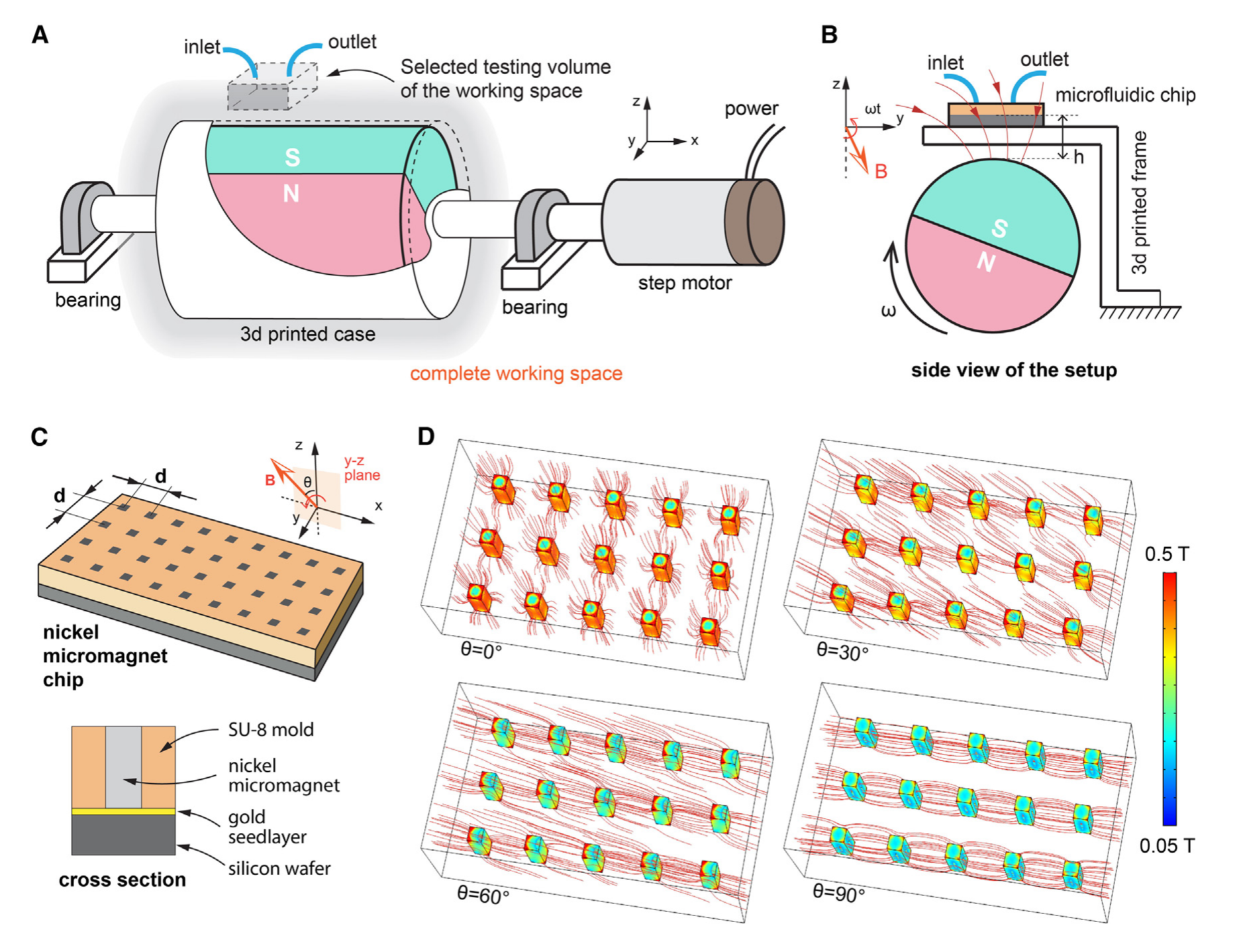
A rotating cylindrical magnet drives collective transport across patterned micromagnets.
A rotating cylindrical magnet drives collective transport across patterned micromagnets. Cropped from Fig. 3 of the linked paper.
01

The distance problem in magnetic separation

A static magnet pulls most strongly near its surface. As the workspace grows, particles farther away experience much less force, so increasing channel size can reduce capture speed and reliability. Simply using a larger magnet does not remove this steep spatial decay.

02

Turning rotation into surface transport

The experiment places a microfluidic chip near a rotating cylindrical permanent magnet. Inside the chip, patterned nickel micromagnets create local landscapes that move as the broad field rotates. Magnetic particles gather into swarms and translate across the surface, including against a perpendicular liquid flow.

03

Why collective motion changes the operating range

Many-particle simulations and experiments reveal two regimes. At moderate driving rates, swarms remain synchronized with the rotating landscape; at higher rates they slip and spread. Resolving that transition helps define the useful frequency range instead of reporting only the fastest isolated demonstration.

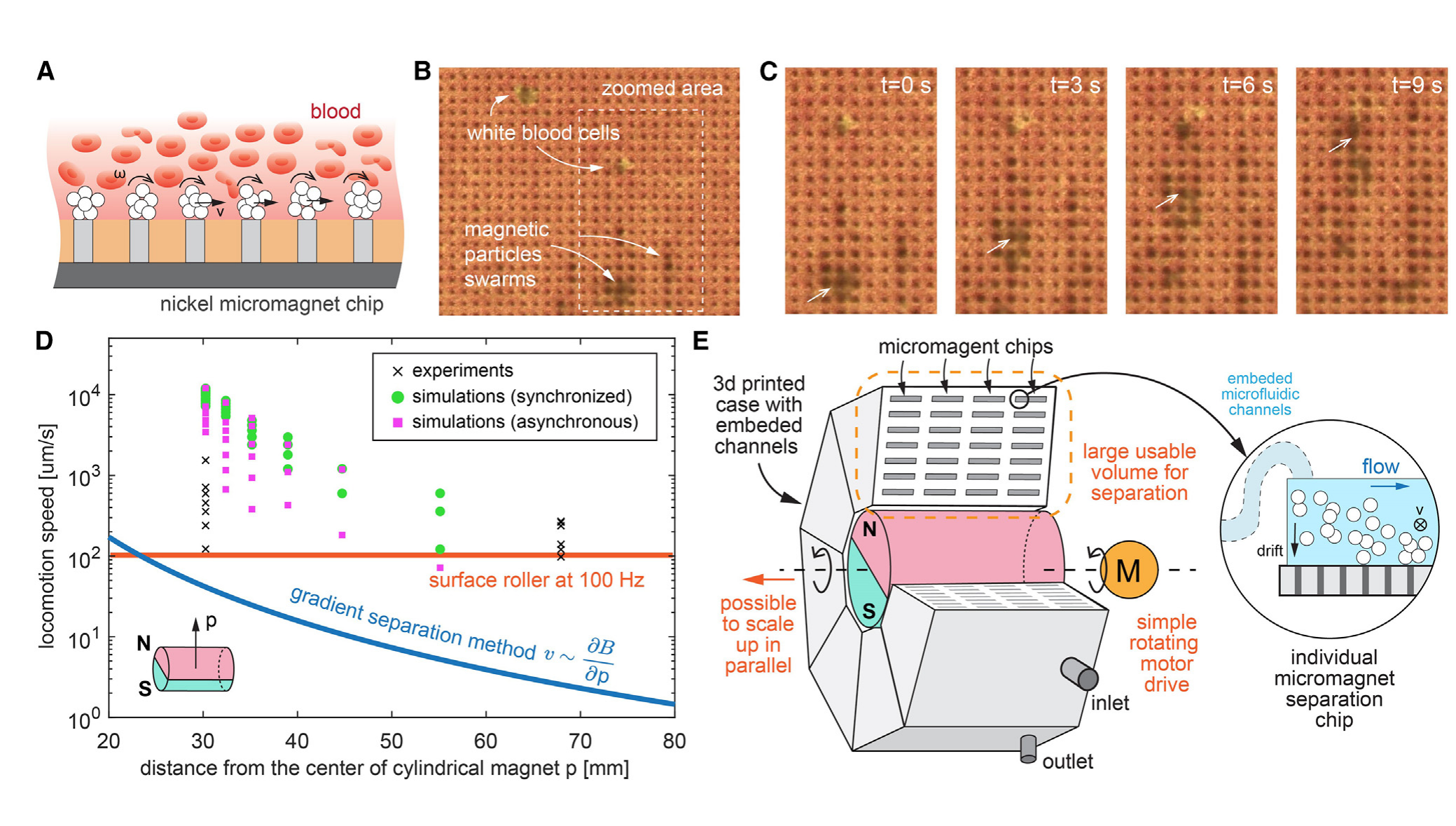
Porcine-blood operation, speed comparison and a proposed parallel multi-chip architecture define the scale-up argument.
Porcine-blood operation, speed comparison and a proposed parallel multi-chip architecture define the scale-up argument. Cropped from Fig. 7 of the linked paper.
04

Benchmarking speed and testing a complex fluid

Across the modeled and experimental comparison range, the reported transport speed is roughly two orders of magnitude above gradient-based separation. A separate experiment in porcine blood shows that the mechanism still operates in a viscous, crowded fluid, although the motion is slower than in simpler liquids.

05

The scale-up claim and its boundary

The experiments use one chip. The proposed next step is to place many chips around the same large rotating field, allowing parallel channels to share the expensive actuation volume. The illustrated system near 100 millilitres per minute is a roadmap, not a completed machine; field uniformity, shear, coagulation, coatings and long-duration blood compatibility remain open questions.