Division of Integrative Systems and DesignHKUST
← All research stories

Create / 2019

Magnetic quadrupoles

Changing the interaction opens a new design space.

THE CENTRAL QUESTION

Can magnetic building blocks form many stable two-dimensional shapes and still remain easy to actuate?

Small permanent magnets behave mainly as dipoles: one end attracts the opposite end of another magnet. That simple rule is excellent for making chains, but it becomes a restriction when the goal is a sheet, a junction or a soft structure with several branches. This project began by asking whether the magnetic interaction itself could be redesigned, so the desired geometry would be natural rather than forced.

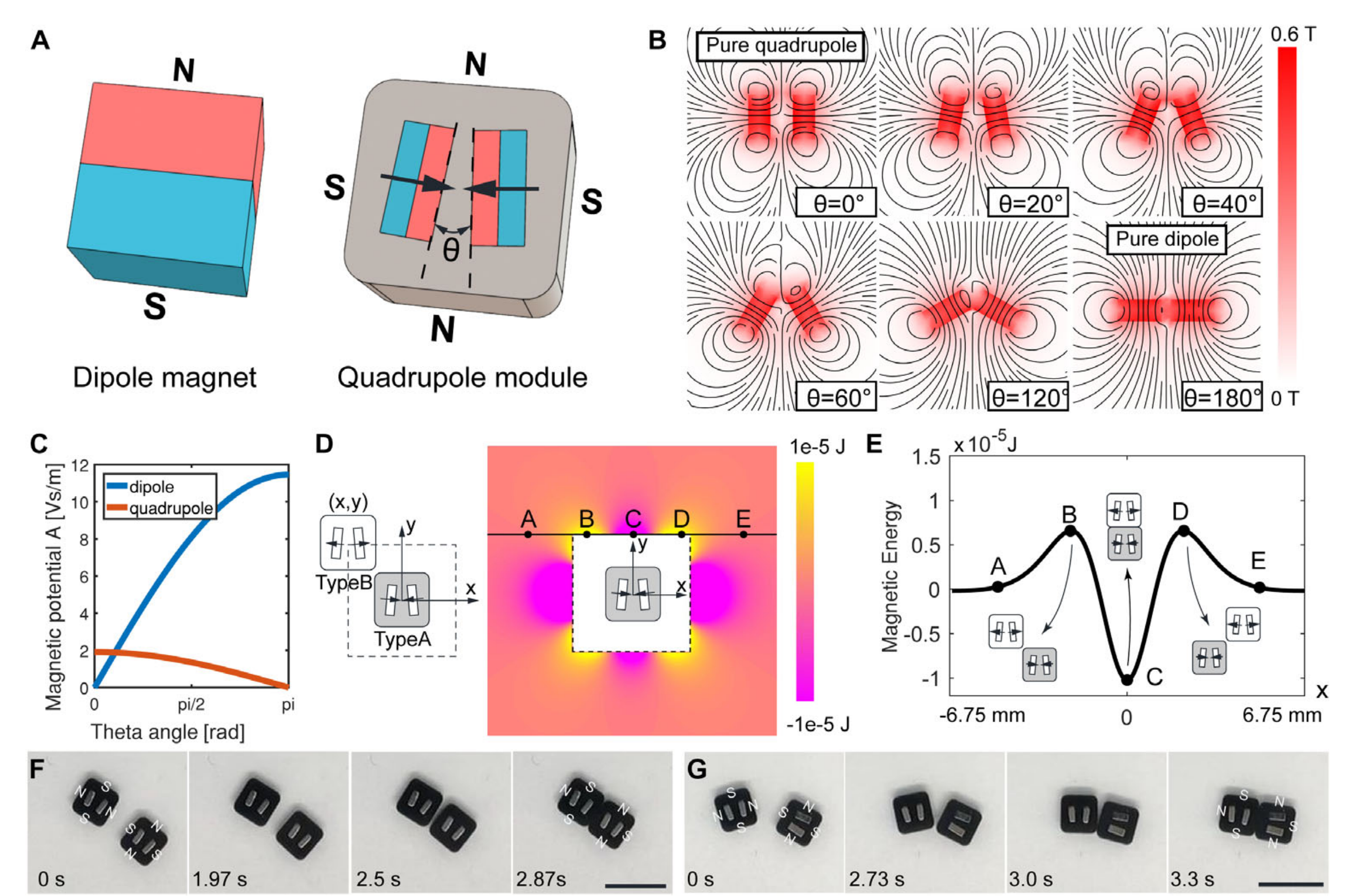
The two-magnet module, tunable multipole field and four-site energy landscape explain stable bonding.
The two-magnet module, tunable multipole field and four-site energy landscape explain stable bonding. Cropped from Fig. 1 of the linked paper.
01

Why ordinary magnets become a design constraint

A dipole has two poles, so neighbouring units usually settle into head-to-tail chains. More complicated arrangements can be assembled, but many bonds then sit in an unfavourable state and the structure becomes fragile. The problem was therefore deeper than finding a better assembly procedure: the basic building block offered the wrong set of preferred connections.

02

A building block with two magnetic personalities

The new module contains two small magnets placed at an angle. Close to the module, their fields combine into a fourfold quadrupole pattern with four preferred bonding directions. Farther away, a weaker dipole remains, allowing the completed structure to respond to a uniform external field. Bonding and actuation are therefore carried by different parts of the same field.

03

Turning the field pattern into something measurable

The team calculated the magnetic energy around a pair of modules and then watched millimetre-scale printed units approach one another. Both the calculation and the experiment showed four stable docking positions. This agreement mattered because it linked the final shapes to a defined energy landscape rather than to trial-and-error assembly.

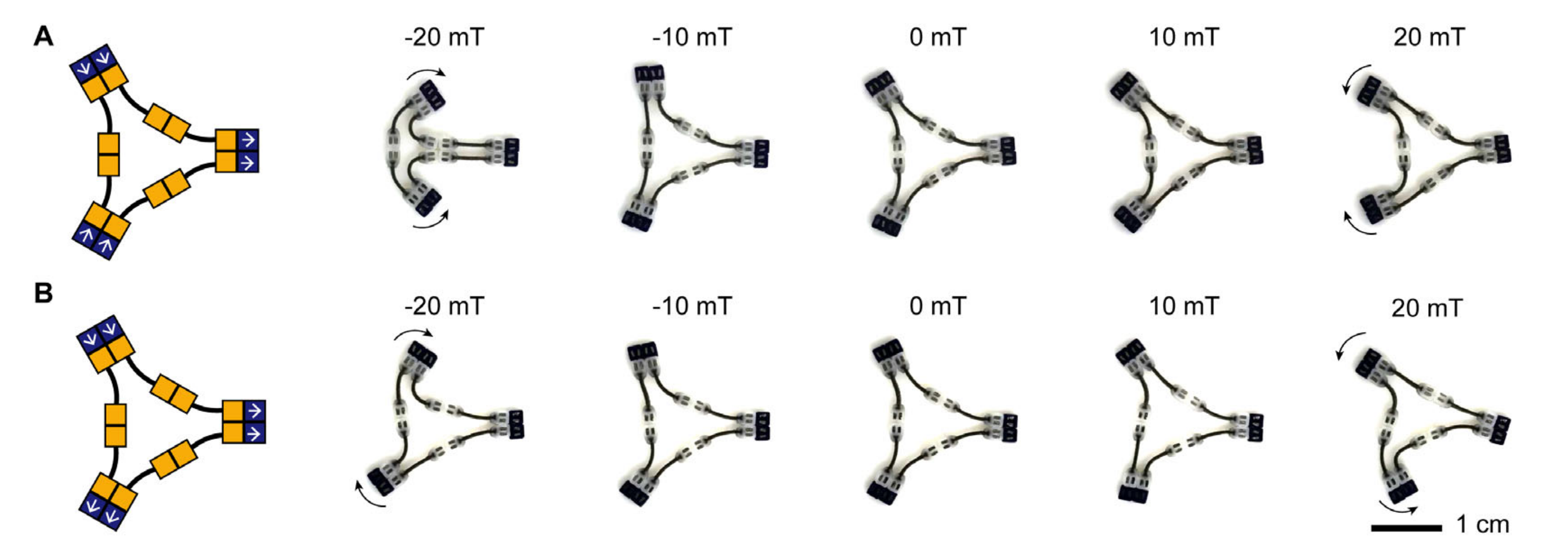
Two differently magnetized assemblies with the same star geometry deform differently under one field sweep.
Two differently magnetized assemblies with the same star geometry deform differently under one field sweep. Cropped from Fig. 4 of the linked paper.
04

Programming different behaviours into the same geometry

Once the modules could form stable two-dimensional arrangements, their remaining dipole directions were selected independently. Two soft star-shaped assemblies with the same geometry but different magnetic programs bent into different shapes during the same field sweep. The structure stored one kind of information in its connections and another in its response to the field.

05

What the work establishes

The broader lesson is that changing interaction symmetry can open a new design space before any robot is built. The demonstrated system is millimetre-scale, planar and limited to a small set of magnetization choices, but it shows a route toward modular materials whose shape and motion can be programmed separately.