Division of Integrative Systems and DesignHKUST
← All research stories

Solve / Create / 2025

Mitochondrial biopsy

Sense, trap and extract an organelle without a fluorescent guide.

THE CENTRAL QUESTION

Can a robot locate and extract mitochondria from a living cell without using a fluorescent label?

Mitochondria carry their own DNA and play central roles in metabolism and disease, but taking a sample from a living cell is difficult. Fluorescent labels can reveal the target, yet they add preparation steps and may disturb the cell. Using one instrument to sense and another to manipulate also creates an alignment problem at submicrometre scales. This project combines both functions at one nanoscale tip and closes the loop with robotic control.

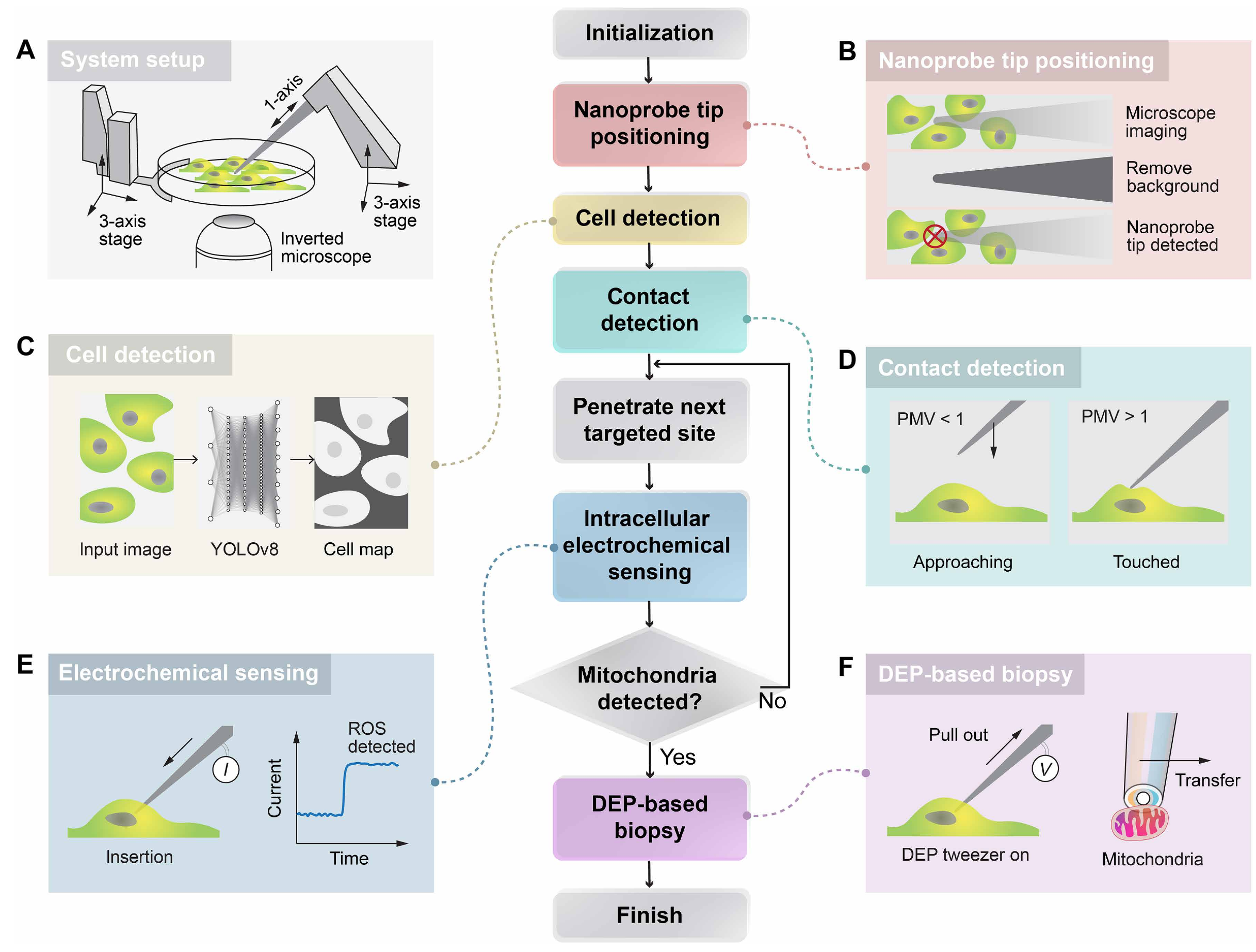
The robotic workflow combines positioning, contact detection, electrochemical sensing and DEP extraction.
The robotic workflow combines positioning, contact detection, electrochemical sensing and DEP extraction. Cropped from Fig. 2 of the linked paper.
01

Finding a target without seeing it directly

Mitochondria produce reactive oxygen and nitrogen species as part of their activity. The probe uses two nanoelectrodes at a tip smaller than 100 nanometres to detect these electrochemical signals. When the current crosses an eight-picoamp threshold, the system treats that location as a mitochondrial target.

02

Using the same tip to sense and trap

After detection, the electronics switch the probe to a one-megahertz dielectrophoretic mode. The resulting local electric field acts as a nanotweezer, drawing the nearby organelle toward the same point that performed the measurement. Co-locating the two functions avoids transferring coordinates between separate tools.

03

Making the procedure repeatable

A robotic stage, micromanipulator, microscope and image analysis plan the approach to each cell. Contact detection identifies the cell surface, motion control standardizes insertion, and the sensing threshold decides when to activate trapping and withdraw the sample. Automation turns a delicate manual action into a sequence that can be timed and evaluated.

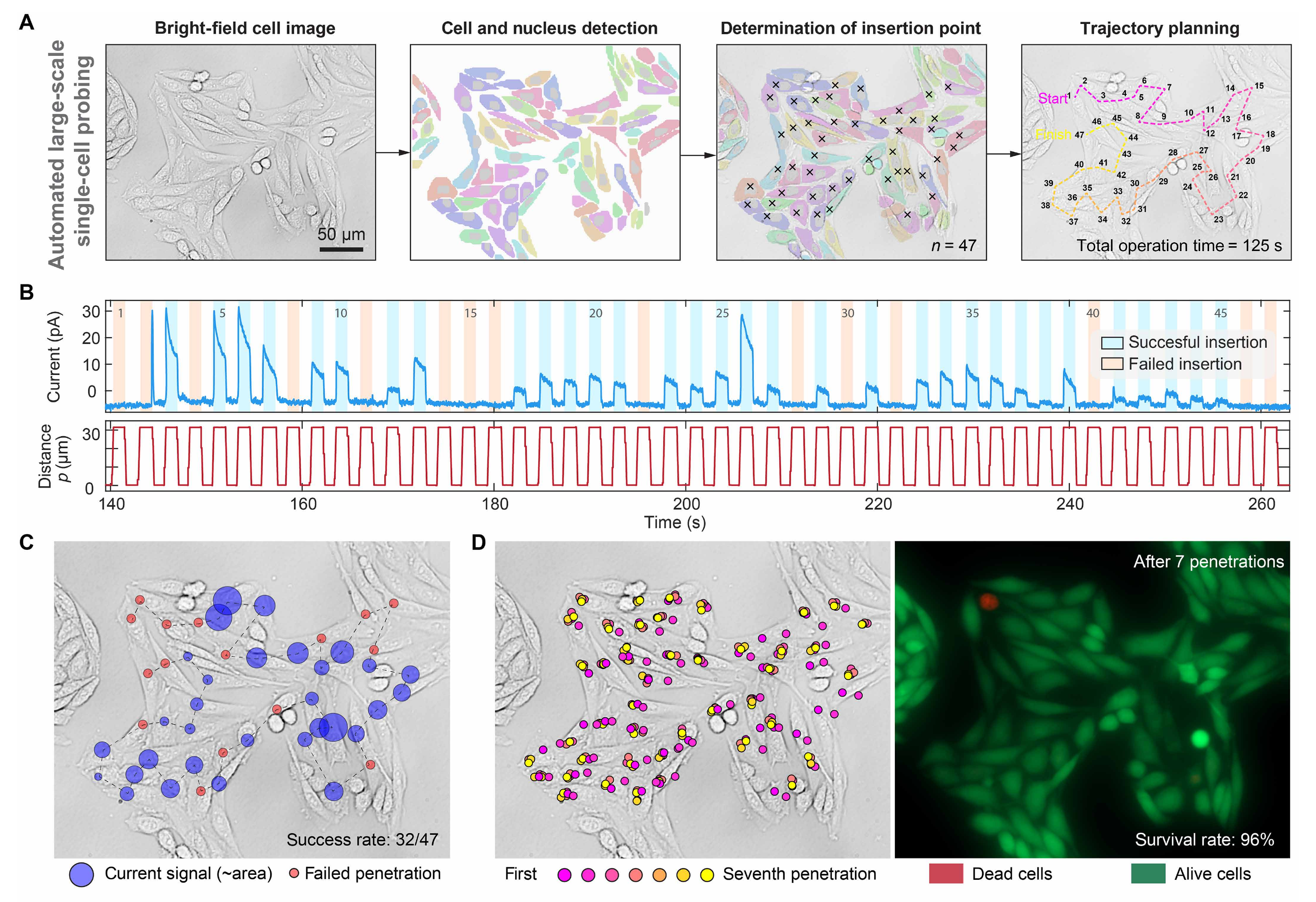
Automated planning and repeated probing quantify penetration success and cell survival.
Automated planning and repeated probing quantify penetration success and cell survival. Cropped from Fig. 5A-D of the linked paper.
04

Evidence from extraction to transplantation

In the reported large-scale run, the system targeted 47 cells in 125 seconds and successfully penetrated 32. Cell survival was 96 percent after repeated probing. Fluorescence, mitochondrial DNA tests and sequencing checked sample identity, while transplantation experiments showed retention in six of nine trials and fusion with the recipient network in four.

05

The remaining experimental gap

The extraction itself is label-free; fluorescent labels were still used in some downstream validation and transplantation experiments. Penetration is imperfect, each biopsy yields very little material, and possible transfer of cytoplasm or RNA complicates purity. The key design principle is broader: when a target is hard to localize, combine detection and manipulation at the same physical point.