Division of Integrative Systems and DesignHKUST
← All research stories

Create / 2022

Artificial microtubules

From a magnetic track to rapid collective transport.

THE CENTRAL QUESTION

Can microscopic cargo move quickly through flowing liquid while remaining attached to a defined route?

Inside a cell, molecular motors do not simply swim toward a destination. They travel along microtubules: physical tracks that define the route and keep transport organized. Many artificial microrobots instead move freely through liquid, where flow, Brownian motion and obstacles can push them away. This project borrowed the track-and-cargo logic of the cell while replacing molecular motors with a magnetic stepping mechanism.

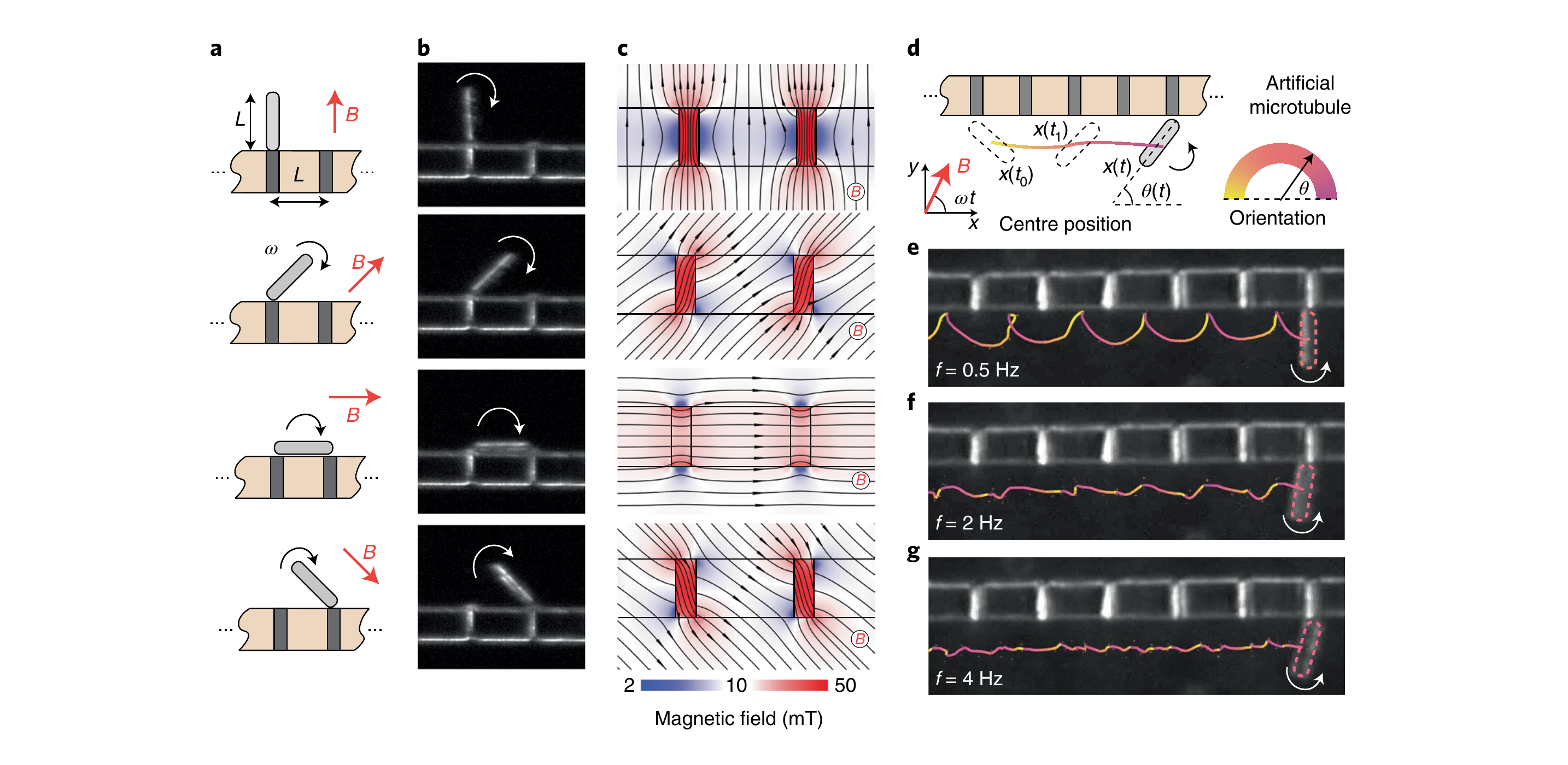
Field-driven microrods step along patterned nickel sites embedded in a microfibre.
Field-driven microrods step along patterned nickel sites embedded in a microfibre. Cropped from Fig. 2 of the linked paper.
01

Why a route can matter as much as a robot

A free swimmer must generate motion, resist external flow and continually correct its direction. A track can take over part of that burden. It constrains where the cargo goes and provides repeated places to anchor, so the driving field can focus on advancing the cargo rather than keeping it from escaping.

02

Building a magnetic stepping track

The artificial microtubule is a polymer fibre containing a regular row of nickel plates. When a magnetic rod approaches a plate, the local field pulls it toward that stepping stone. As a uniform external field rotates, the rod alternates between anchoring and rolling, moving forward by two steps during each complete rotation.

03

Connecting motion to a physical model

Experiments measured trajectories across different driving frequencies and flow conditions. An overdamped model described the balance among magnetic torque, attraction to the stepping stones and fluid drag. The model explained when a rod follows the field smoothly, when it slips and how the geometry sets the distance travelled per cycle.

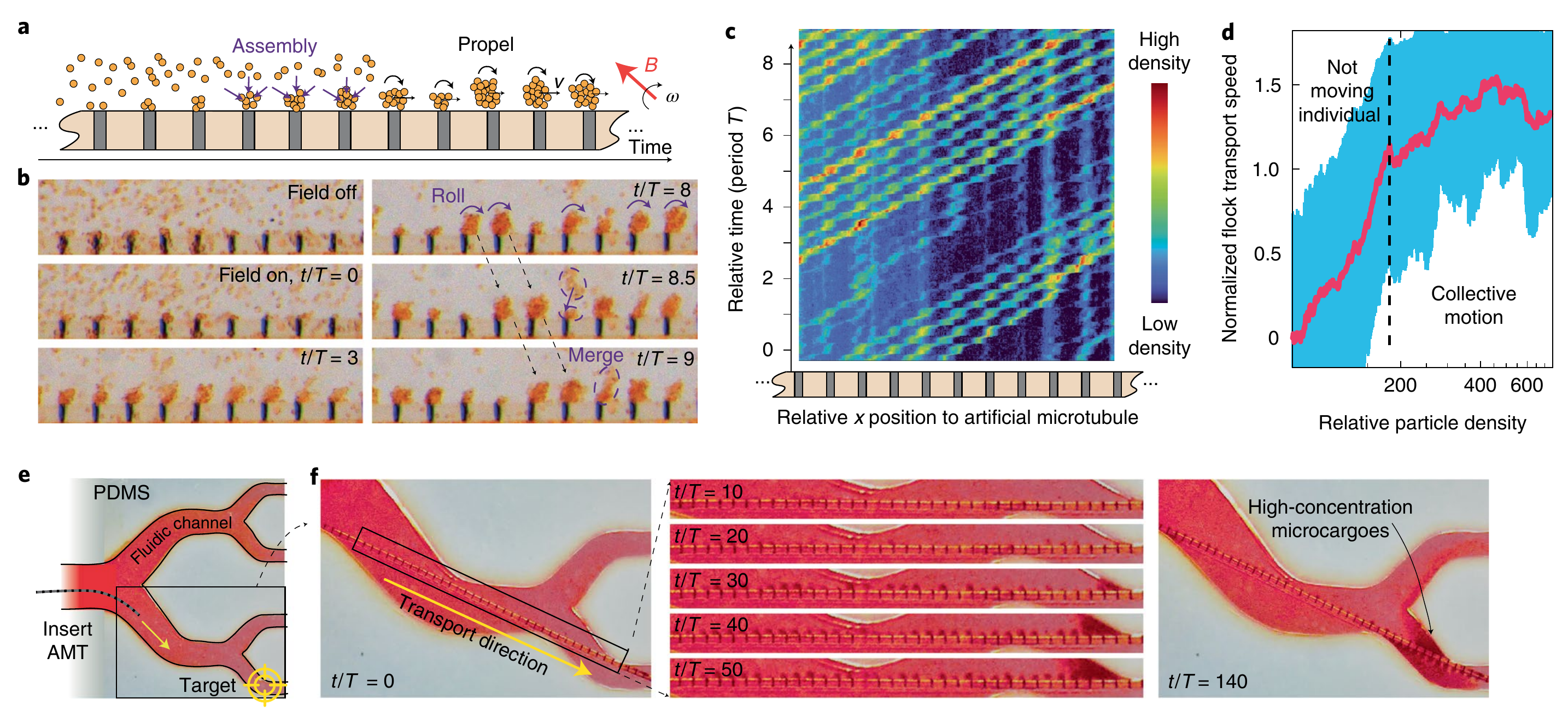
Dense cargo assemblies bridge steps and reach a chosen target in a branching channel.
Dense cargo assemblies bridge steps and reach a chosen target in a branching channel. Cropped from Fig. 5 of the linked paper.
04

When many particles help one another

Individual particles can become trapped between stepping stones. At higher density, however, neighbouring particles form a moving cluster that spans the gap and shares the drag. These collective assemblies crossed defects that stopped isolated cargo and could be directed to accumulate at a chosen branch in a microfluidic network.

05

Performance and remaining boundaries

At matched driving frequency, the reported normalized speed was about an order of magnitude above typical magnetic swimmers. The price of this speed and robustness is infrastructure: the route must be fabricated and positioned in advance, and cargo size must be compatible with the track. The demonstrations remain benchtop experiments rather than transport in living tissue.