Division of Integrative Systems and DesignHKUST
← All research stories

Understand / Create / 2020

Magnetic cilia

Making collective motion experimentally accessible.

THE CENTRAL QUESTION

How does the wave formed by many beating cilia change the fluid they transport?

The airways, reproductive system and many microorganisms move fluid with carpets of hair-like cilia. Neighbouring cilia do not all beat together; small timing differences create a travelling metachronal wave. Biology makes these waves look effortless, but it is difficult to prescribe the timing of hundreds of living cilia and then vary one feature at a time. The project created an artificial carpet in which the collective pattern could be written, reproduced and measured.

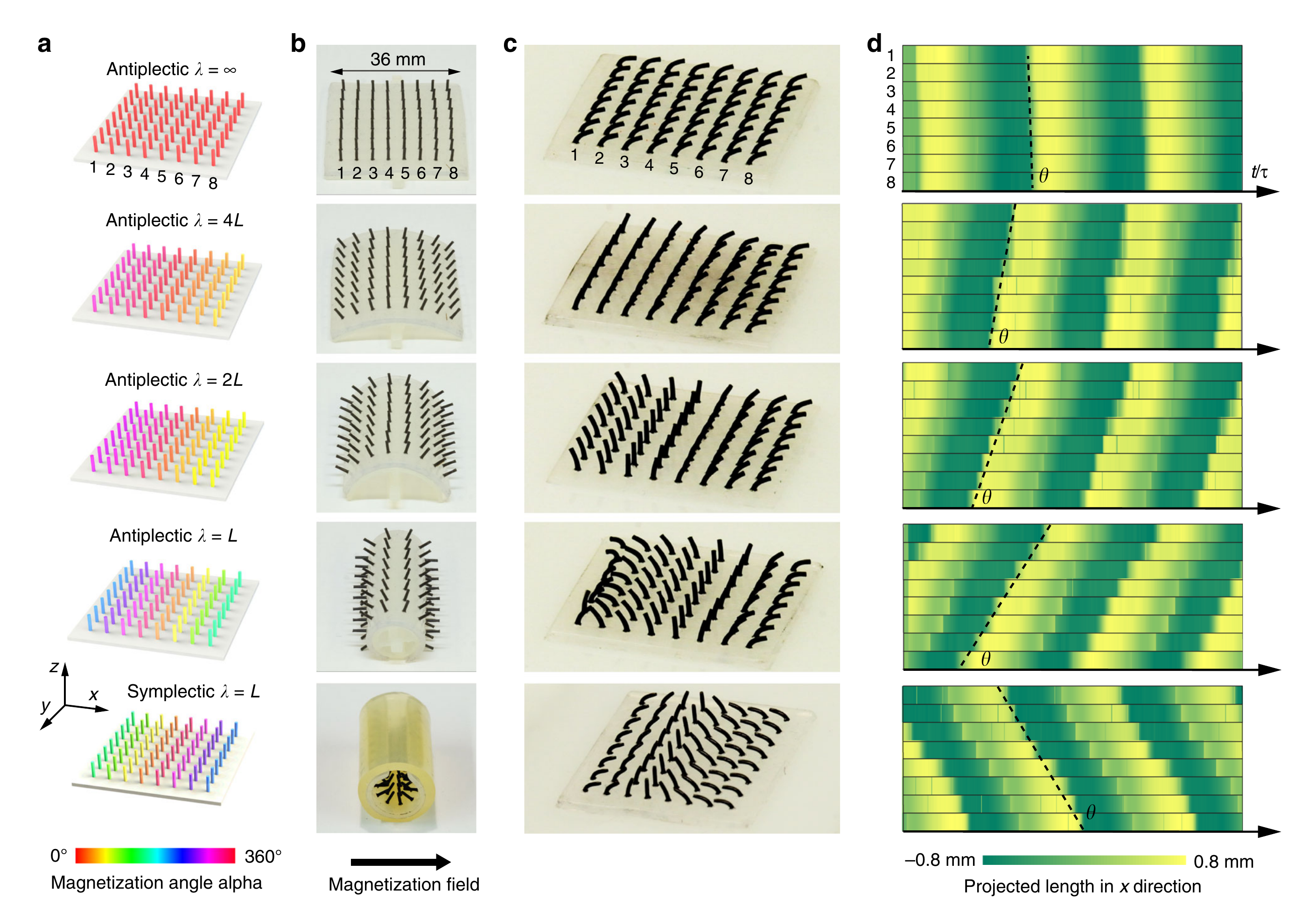
Curved magnetization templates program travelling metachronal waves across a magnetic cilia carpet.
Curved magnetization templates program travelling metachronal waves across a magnetic cilia carpet. Cropped from Fig. 3 of the linked paper.
01

From a biological observation to a controllable question

In a living tissue, wave direction, wavelength, cilia spacing, elasticity and surrounding fluid all interact. That richness makes it hard to isolate cause and effect. An artificial model system can be simpler: it keeps the timing and fluid interaction that matter while allowing the wave pattern to be changed deliberately.

02

Writing phase into a soft magnetic carpet

More than 200 flexible cilia were made from a silicone composite containing magnetic particles. During magnetization, the carpet was wrapped around a curved template. Each cilium therefore stored a slightly different magnetic direction, which is equivalent to storing a delay, or phase, between neighbouring beats.

03

One global field creates a travelling wave

After programming, the entire carpet was driven by the same rotating magnetic field. The stored differences caused neighbouring cilia to bend at different times, producing a wave without separate wires or controllers for each element. A mechanical rod model connected the magnetization pattern, cilium bending and observed phase maps.

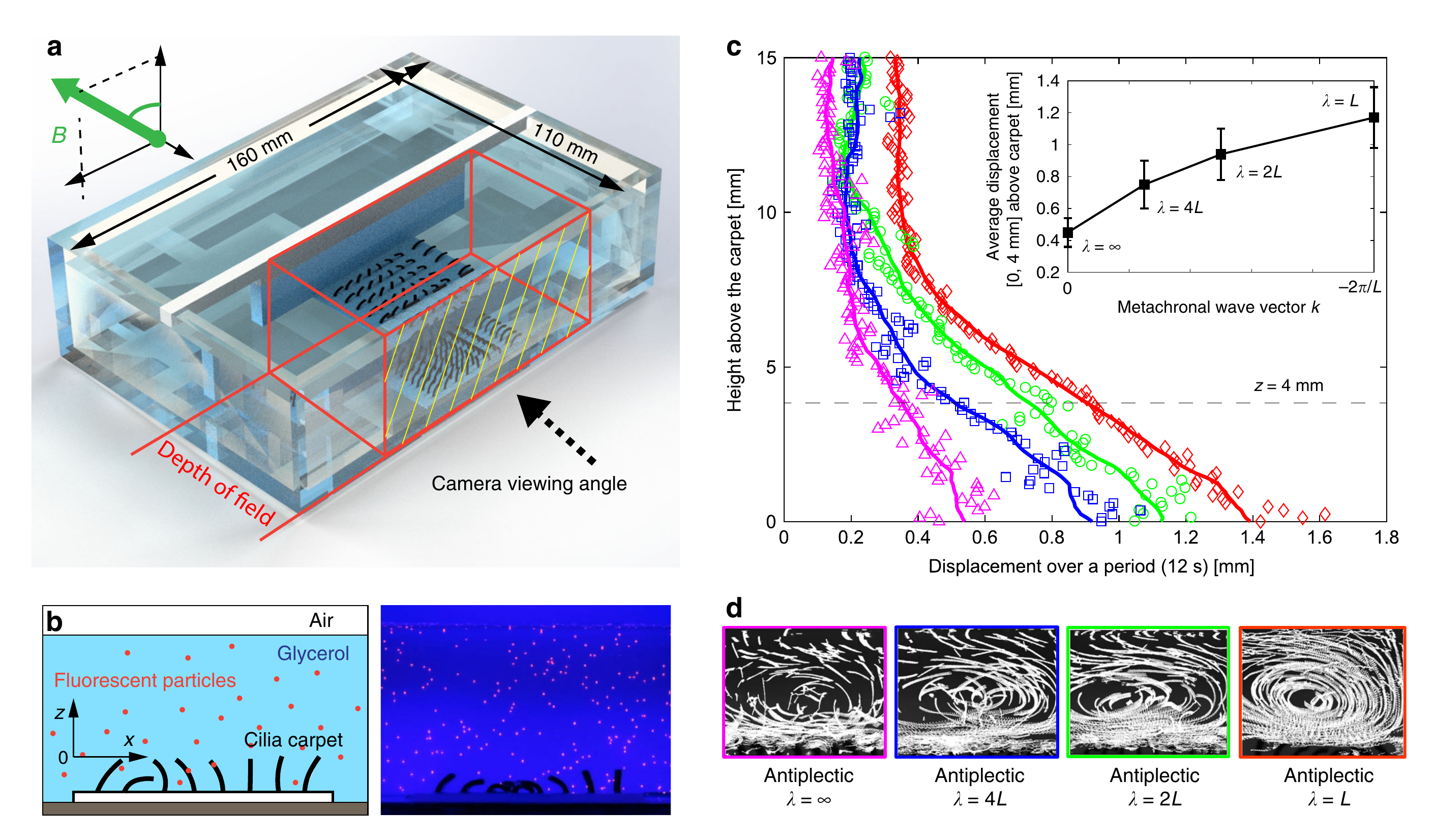
Wavelength and cilia density determine tracer transport and coherent flow.
Wavelength and cilia density determine tracer transport and coherent flow. Cropped from Fig. 4 of the linked paper.
04

Watching the fluid respond

Fluorescent tracer particles made the resulting flow visible. Across the tested conditions, shorter antiplectic waves transported tracers farther than synchronous beating; the shortest tested wavelength produced roughly three times the displacement and a more coherent vortex. Changing cilia density also changed whether the strokes reinforced one another or became crowded.

05

What the carpet teaches us

The carpet is both a robotic surface and an experimental instrument. It shows how material memory can replace many individual control channels, while giving researchers a way to study collective transport. The present evidence comes from millimetre-scale cilia in a viscous benchtop fluid, so translation to biological scales or low-viscosity flows requires new designs and tests.