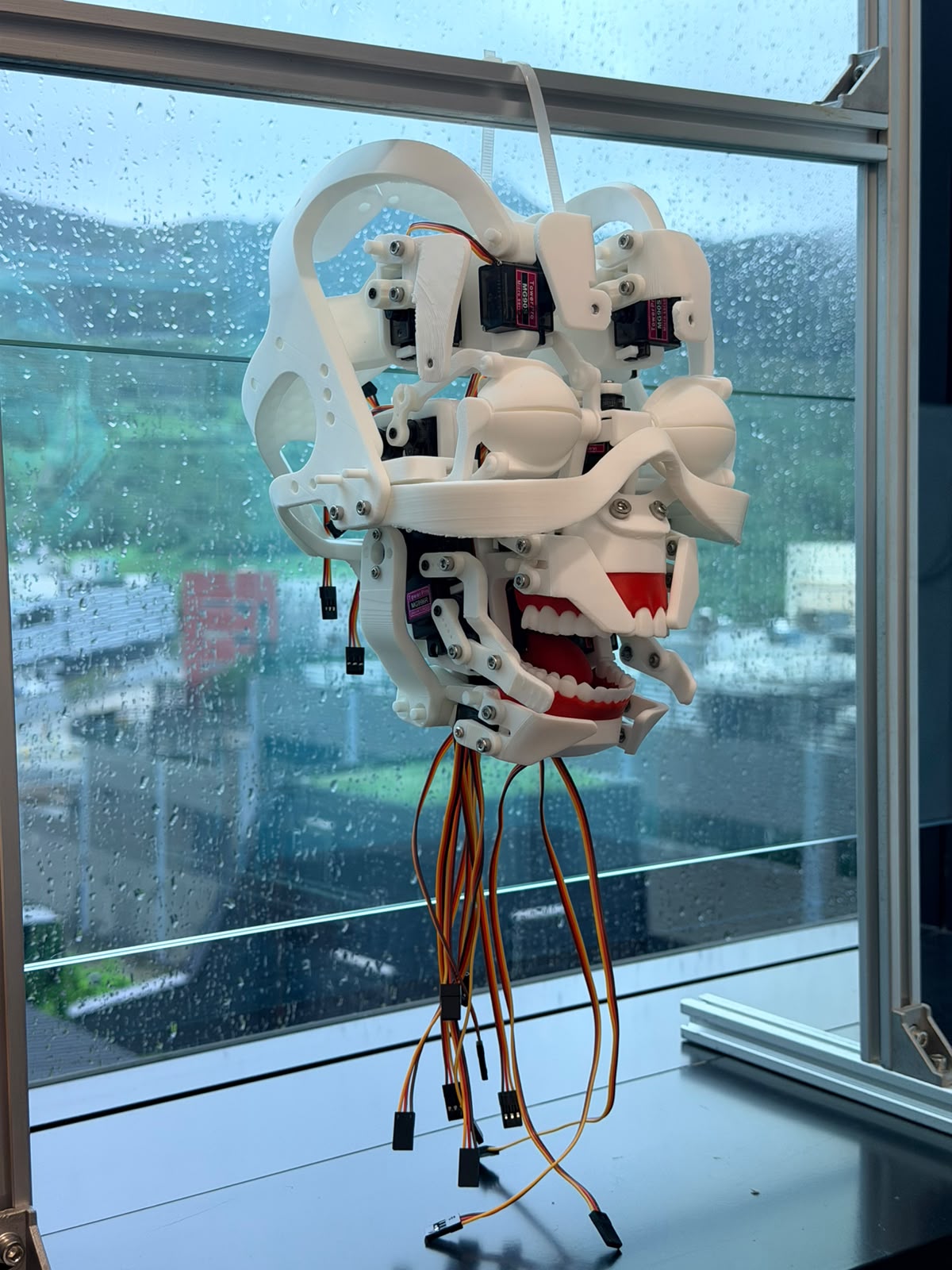
A fourth-year studio course about making robotic motion feel expressive, intentional and alive.
A modular face turns mechanism design, control and expression into one visible system.
THE DESIGN QUESTION
How can a robot move in a way that appears expressive, intentional and life-like?
Students learn by building a face whose mechanical choices are immediately visible. A small change in trajectory, timing or coordination can turn a natural expression into an uncanny one. The course therefore connects mechanism design, electronics, programming and artistic judgement through one demanding physical system.
PHASE 01
Replicate and understand
Teams first reproduce an open-source robotic human face. They build the eye, eyelid, eyebrow and mouth modules, study how servo rotation becomes a desired feature trajectory, integrate roughly 30–40 actuators where appropriate, and program smooth target expressions.
PHASE 02
Redesign and perform
Each team then creates an original human, animal or animated face or creature. Students redesign mechanisms for its anatomy, add expressive features such as ears or whiskers, coordinate its motion and finish with a choreographed face dance synchronized to music.
WHAT STUDENTS LEARN
From one moving joint to an expressive machine.
01
Mechanism and motion
Translate desired eye, eyelid, eyebrow and mouth trajectories into linkages, joints and constraints.
02
Actuators and transmission
Select and use servo motors with an understanding of torque, speed, range, gearing and positional control.
03
Hardware integration
Resolve mounting, collision, wiring, power distribution, calibration and repeatability across many actuators.
04
Coordinated control
Program interpolation, timing, sequencing and continuous transitions rather than isolated motor commands.
05
Life-like expression
Use rhythm, asymmetry, exaggeration and recovery to make an intended emotion readable.
06
Creative robotic design
Develop, justify and communicate a new robotic character through hardware, software and performance.
THIRTEEN-WEEK ARC
A shared foundation, then an open design challenge.
WEEKS 1–3Motion foundations and expressive eyes
Servo control, linkage trajectories, eyeball motion, eyelids and gaze.
WEEKS 4–6Eyebrows, mouth and head integration
Facial feature mechanisms, assembly, interference, wiring and calibration.
WEEKS 7–8Coordinated motion
Multi-servo electronics, continuous transitions and target expressions.
WEEKS 9–12Original face or creature
Proposal, mechanism redesign, fabrication, software integration and choreography.
WEEK 13Robotic face performance
Design explanation, expression demonstration and music-synchronized face dance.
ASSESSMENT
Technical reliability and expressive quality carry equal weight.
20%Individual mechanisms, programming and lab work
25%Open-source face replica and target expressions
45%Custom robotic face and final performance
10%Individual design reflection and contribution record